Innovation Lever 1
The Greenhouse Agreement™ — Establishing Environmental Safety & a Powerful Innovation Culture
Core Focus: Establishing permanent, routine safety for curiosity and innovative thinking while maintaining and enhancing team productivity.
Time Commitment: 15–30 minutes asynchronous preparation (Drop-In Study Hall) + 60–90 minute facilitated team session.
Overview: Brainstorming sessions are great, but they aren't enough to lead to remarkable unlocks in productivity for your team. In this step, your team will discover the science behind why traditional "brainstorming" methods fail to lead to sustainable organizational shifts and uncover how this may be showing up currently in your organization. Then they will be introduced to a completely new and transformational way to make space for innovation—by building it into day-to-day organizational culture from the ground up by creating a Greenhouse Agreement™ which enables an environment where innovation can grow.
Session Structure
- Video (5 mins): Uncover the science of why standard brainstorming sessions fail to produce lasting shifts
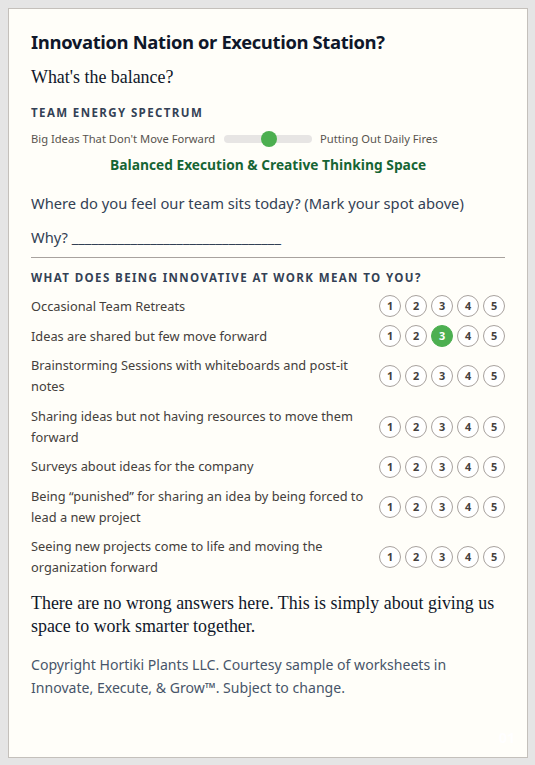
- Culture Exploration (30 mins): Identify where these patterns and other barriers show up in daily team routines.
- The Greenhouse Agreement™ (25 min): Establish the core team pact to embed permanent, routine safety for curiosity and innovative thinking without sacrificing productivity.
Research Grounding: Aligned with organizational psychology research on psychological safety and workplace culture, which shows that establishing routine environmental safety for curiosity breaks cognitive rigidity and builds sustainable innovative habits [1]. This Lever channels initial team openness into a lasting foundation for cultural transformation.
Tangible Team Deliverable: The Workplace Canopy™ Alignment Canvas & Team Pact, converting standard brainstorming routines into a real architectural reconstruction of daily team culture.
Innovation Lever 2
Curiosity & Friction — Harnessing Real Operational Friction
Core Focus: Turning daily pet peeves, clunky tools, and customer complaints into constructive design fuel.
Time Commitment: 15–30 minutes asynchronous preparation (Drop-In Study Hall) + 60–90 minute facilitated team session.
Overview: When people are asked to stay positive in corporate meetings, they tend to offer safe, minor suggestions. Lever 2 provides a constructive outlet for genuine workplace frustrations—like broken tools, repetitive tasks, and client complaints—and channels that energy into targeted opportunities for improvement.
Session Structure
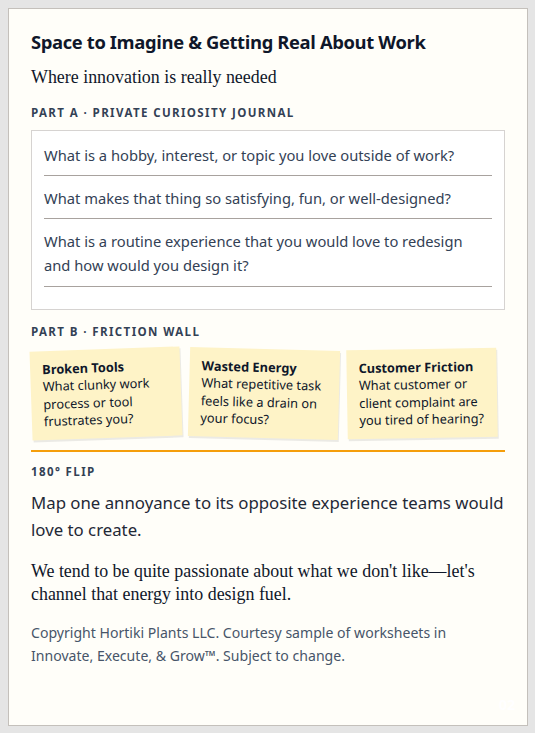
- Study Hall Journal Review (15 min): Share reflections from the private pre-session curiosity journal.
- Friction Extraction (30 min): Categorize team annoyances across broken tools, wasted energy, and customer friction.
- The 180° Flip (15 min): Reframe top operational complaints into their direct positive opposite experiences.
Research Grounding: Aligned with cognitive research on problem inversion and lateral thinking, which shows that reversing standard problem perspectives breaks cognitive rigidity and uncovers hidden operational bottlenecks [2]. This Lever channels natural workplace complaints into productive diagnostic inputs.
Tangible Team Deliverable: The Friction Wall & 180° Flip Canvas, converting top team annoyances into clear targets for operational redesign.
Innovation Lever 3
Expansive Solutions — Exploring High-Altitude Possibilities
Core Focus: Generating ambitious solution concepts without premature budget or logistical shutdown.
Time Commitment: 15–30 minutes asynchronous preparation (Drop-In Study Hall) + 60–90 minute facilitated team session.
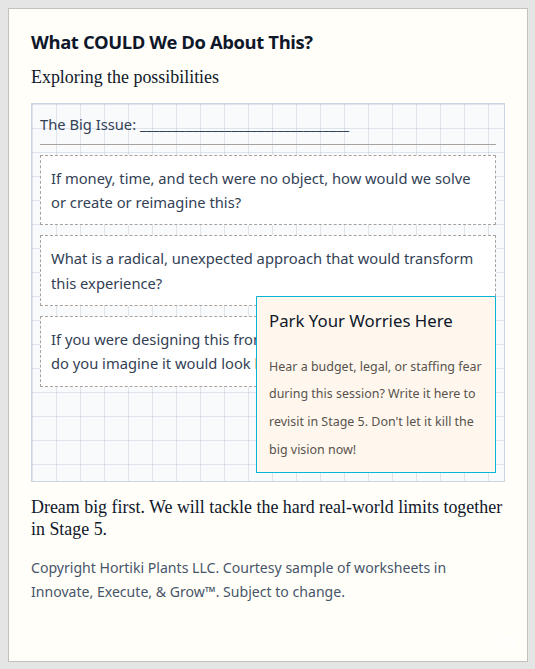
Overview: Moving into solution thinking often causes teams to shrink their vision to fit current constraints. Lever 3 gives teams room to explore wide-open, high-altitude ways to solve identified friction points. Any real-world limits that arise (such as budget, legal, or staffing fears) are safely logged on a parked board to be addressed later in Lever 5.
Session Structure
- Blueprint Framing (15 min): Set up the open blueprint canvas and set aside immediate real-world limits.
- Unconstrained Exploration (30 min): Develop ambitious solution concepts using future-focused lenses.
- Constraint Parking (15 min): Log budget, legal, and timing concerns onto the Parked Constraints board.
Research Grounding: Aligned with research on deferred judgment during early-Lever ideation, which demonstrates that separating unconstrained exploration from immediate risk analysis increases idea novelty and prevents premature project shutdown [3]. This Lever protects expansive thinking while preserving real-world concerns for later review.
Tangible Team Deliverable: The High-Altitude Solution Canvas, featuring unconstrained solution concepts alongside a documented Parked Constraints list.
Innovation Lever 4
Connection Bridge — Finding Cross-Project Synergies
Core Focus: Eliminating redundant initiatives and connecting overlapping efforts across teams.
Time Commitment: 15–30 minutes asynchronous preparation (Drop-In Study Hall) + 60–90 minute facilitated team session.
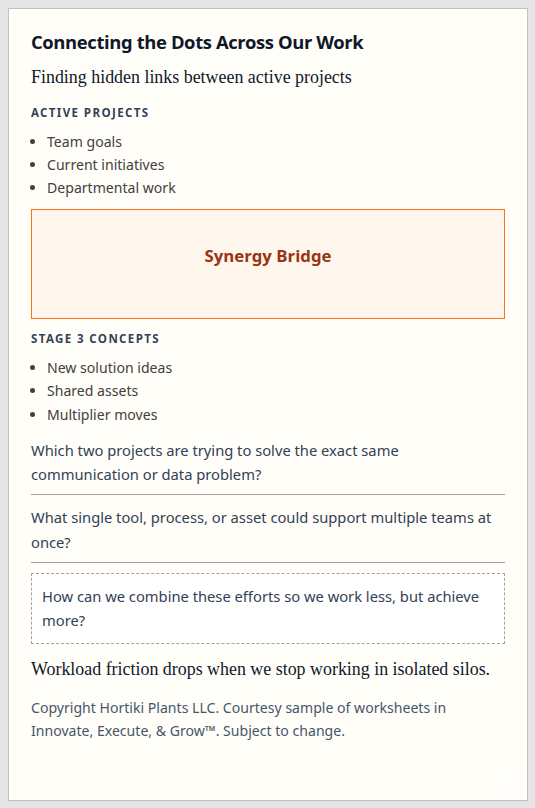
Overview: Teams are frequently burned out not from a lack of effort, but because they are managing isolated projects that compete for the same resources. Lever 4 maps active departmental goals alongside Lever 3 solution concepts to find hidden links, allowing one well-designed initiative to support multiple goals at once.
Session Structure
- Project Inventory (15 min): Lay out active team projects alongside new solution ideas.
- Overlap Mapping (30 min): Identify shared data, tools, and processes across initiatives.
- Synergy Design (15 min): Combine redundant efforts into single high-leverage moves.
Research Grounding: Aligned with organizational research on portfolio synergy and cognitive load reduction, which shows that consolidating redundant initiatives across departments reduces workload friction and improves execution focus [4]. This Lever guides teams to combine overlapping efforts into single, high-impact moves.
Tangible Team Deliverable: The Cross-Project Connection Bridge, mapping shared assets, combined workflows, and portfolio synergies across team initiatives.
Innovation Lever 5
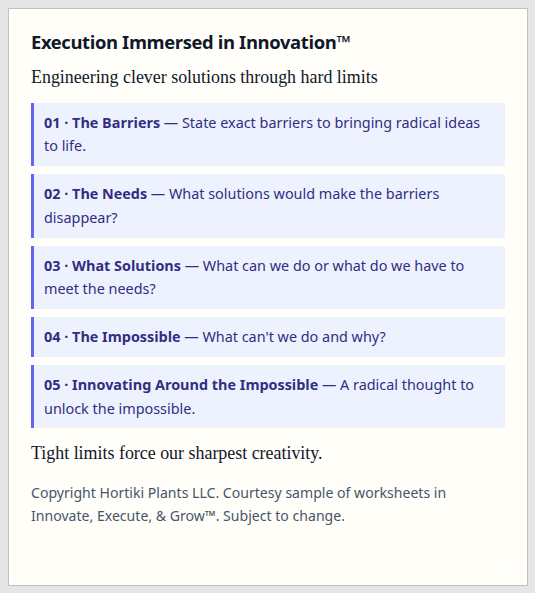
Constraint Interrogation — Engineering Workarounds Through Limits
Core Focus: Turning real-world budget, legal, and timing barriers into creative design advantages.
Time Commitment: 15–30 minutes asynchronous preparation (Drop-In Study Hall) + 60–90 minute facilitated team session.
Overview: In Lever 5, parked real-world limits enter the spotlight. Rather than letting constraints kill promising ideas, teams apply a structured 5-step interrogation loop (What DO we have? What solutions exist? What is impossible and why?) to design clever operational workarounds.
Session Structure
- Unpark Barriers (15 min): Select top parked budget, legal, or staffing constraints from Lever 3.
- Interrogation Flow (30 min): Walk through the 5-step interrogation loop to identify available assets and workarounds.
- Workaround Model (15 min): Re-engineer radical ideas into practical, low-barrier execution plans.
Research Grounding: Aligned with empirical research on constraint-based creativity, which establishes that structured operational limits act as catalysts for innovative problem-solving and workaround design [5]. This Lever enables teams to turn rigid obstacles into practical execution pathways.
Tangible Team Deliverable: The Constraint Interrogation Decision Board, mapping hard real-world limits to actionable, re-engineered operational models.
Innovation Lever 6
Transformative Priority Matrix — Filtering for Highest-Impact Unlocks
Core Focus: Filtering initiatives by their potential to transform team operations rather than defaulting to minor tweaks.
Time Commitment: 15–30 minutes asynchronous preparation (Drop-In Study Hall) + 60–90 minute facilitated team session.
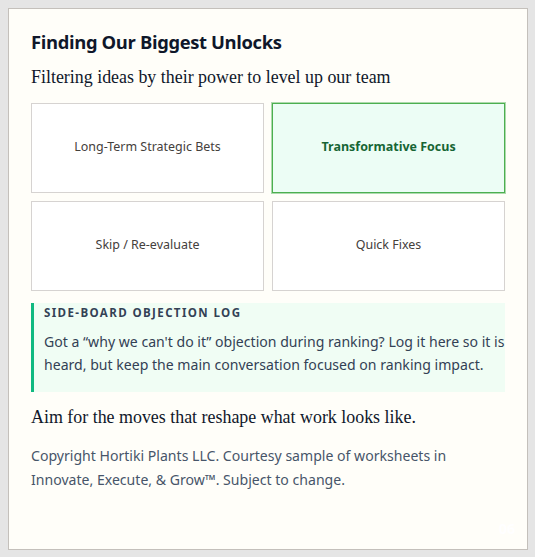
Overview: Traditional planning often defaults to "low-hanging fruit"—small, easy tasks that produce minimal long-term impact. Lever 6 evaluates opportunities based on their ability to fundamentally level up team capacity. Hesitations and objections are logged neutrally on a side board so risk concerns are heard without derailing strategic priorities.
Session Structure
- Matrix Setup (15 min): Plot solution proposals across Transformative Level and Team Impact.
- Priority Ranking (30 min): Identify high-impact focus areas while logging objections on the side board.
- Target Selection (15 min): Select 1–2 primary unlocks for immediate team focus.
Research Grounding: Aligned with research on outcome-driven prioritization and decision bias, which shows that teams frequently default to low-impact tasks unless guided by structured evaluation frameworks that surface category-defining breakthroughs [6]. This Lever helps teams align around high-leverage opportunities while validating risk concerns neutrally.
Tangible Team Deliverable: The Transformative Priority Matrix, highlighting top-tier team unlocks alongside a logged Side-Board Objection record.
Innovation Lever 7
Ecosystem Architecture — Mapping Macro Pillars & Micro-Details
Core Focus: Outlining foundational support structures and applying creative curiosity to routine touchpoints.
Time Commitment: 15–30 minutes asynchronous preparation (Drop-In Study Hall) + 60–90 minute facilitated team session.
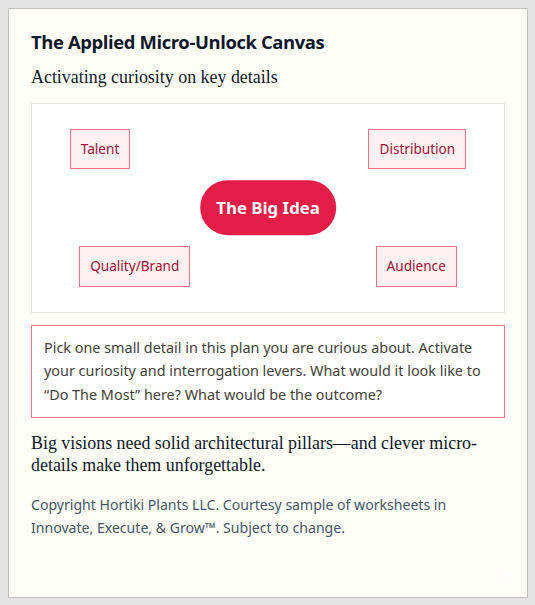
Overview: Major plans fail when the surrounding operational ecosystem cannot support them. Lever 7 maps out the required pillars (talent, distribution, quality, audience) needed to sustain an initiative. Teams then explore granular touchpoints to turn routine execution steps into memorable value drivers.
Session Structure
- Ecosystem Mapping (15 min): Define what must be true across talent, quality, distribution, and audience pillars.
- Micro-Detail Exploration (30 min): Apply creative curiosity to specific operational touchpoints.
- Action Alignment (15 min): Finalize micro-unlock specifications for upcoming execution.
Research Grounding: Aligned with research on backward design and task detail optimization, which demonstrates that mapping foundational ecosystem requirements backward from a target end-state significantly improves execution clarity and outcome quality [7]. This Lever structures both macro operational support and micro-touchpoint enhancements.
Tangible Team Deliverable: The Ecosystem Architecture Blueprint & Micro-Unlock Specifications, detailing macro support pillars and micro-detail execution plans.
Innovation Lever 8
Culture Covenant — Sustaining Momentum & Weekly Rhythms
Core Focus: Reflecting on team growth, cementing psychological safety, and locking in standing operational habits.
Time Commitment: 15–30 minutes asynchronous preparation (Drop-In Study Hall) + 60–90 minute facilitated team session.
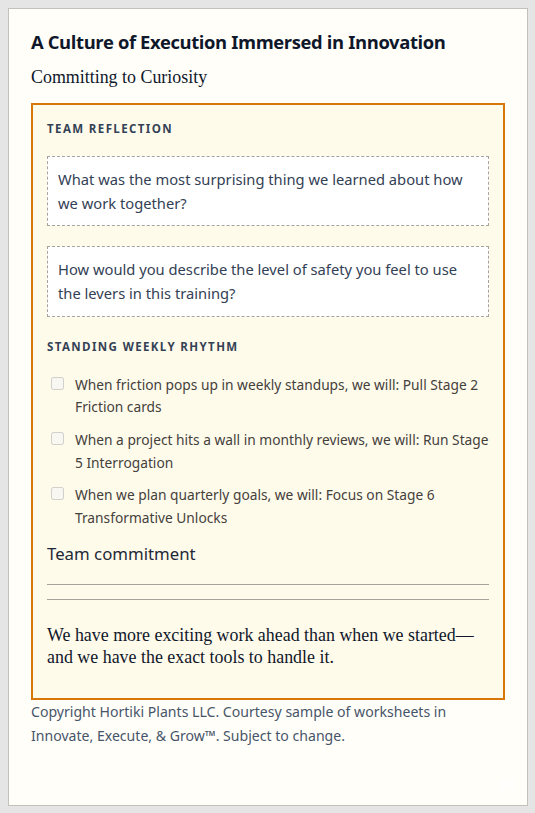
Overview: Lever 8 shifts focus from specific project deliverables to long-term cultural integration. The team reflects on their growth, evaluates their communication safety, and establishes simple, recurring habits for pulling these 8 levers during weekly standups, monthly reviews, and quarterly planning.
Session Structure
- Team Retrospective (20 min): Reflect on communication growth, psychological safety, and shared insights.
- Rhythm Integration (25 min): Define specific actions for weekly standups, monthly reviews, and quarterly planning.
- Covenant Sign-off (15 min): Finalize and sign the team culture agreement.
Research Grounding: Aligned with longitudinal research on team reflexivity, which proves that recurring, structured reflection cycles directly enhance long-term team adaptability, trust, and continuous performance [8]. This Lever locks in recurring operational habits to sustain long-term team momentum.
Tangible Team Deliverable: The Team Culture Covenant & Standing Weekly Rhythm Poster, signed by the team with explicit commitments for ongoing operational reviews.